
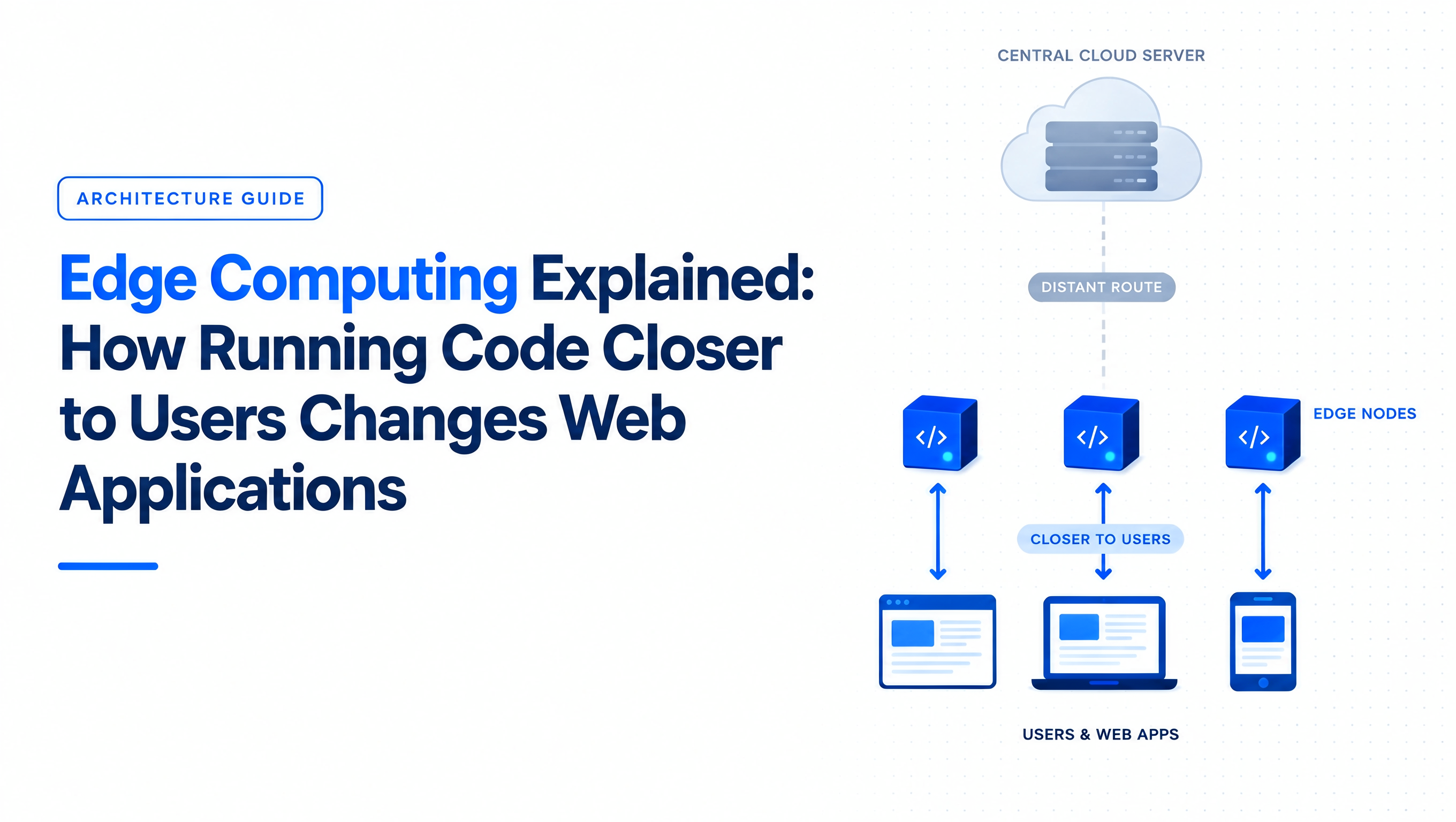
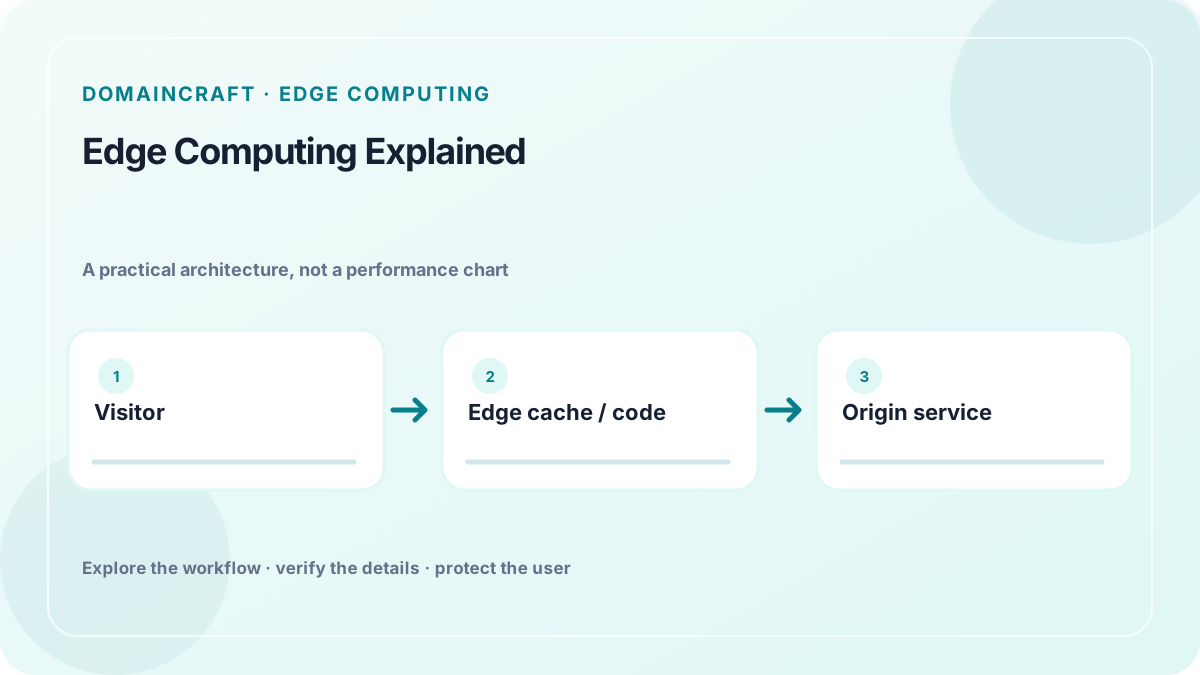
 Original local vector schematic. It is explanatory artwork, not measured performance or market data.
When someone in one region visits an application hosted far away, every network round trip adds distance and potential delay. Edge computing places selected data or code nearer to users, often at points of presence operated by a content delivery network or cloud provider. It can make some requests faster and reduce repeated work at an origin. It does not make every application globally low-latency, and it does not remove the need for a reliable origin, careful caching, or authorization.
Quick answer: Centralized computing runs most application logic in a small number of regions; edge computing runs a subset of that logic in distributed locations near visitors. A CDN cache can serve reusable content without executing application code, while an edge function can inspect or transform a request. Use the edge for work that is small, safe to distribute, and tolerant of the platform’s runtime limits.
Centralized origin, distributed edge
In a centralized design, a browser connects to a known origin region where the application and data live. DNS resolution and network routing direct the request, a proxy may terminate TLS, and the origin processes it. A content delivery network can sit between the browser and origin, storing copies of static files such as images or stylesheets.
An edge network has many geographically distributed points of presence. The provider routes a request toward a suitable location according to its network and product policy. The edge may return a cached object, run a function, or forward the request to an origin. “Nearby” usually means closer in network terms, not necessarily the nearest point on a map, and the route can change.
The edge and origin are complementary. The origin often remains the source of truth for account data and durable writes. The edge can accelerate public static assets, perform simple routing, or make an early decision before forwarding a request.
CDN caching and edge functions are different
A CDN cache stores a reusable response. If a request matches a valid cache key and the response is fresh, the edge can return it without contacting the origin. Cache headers, provider rules, and invalidation behavior determine how long an object may be reused. A poorly chosen cache key can mix one user’s content with another’s; an overly broad cache policy can expose personalized data.
An edge function runs code at or near the network edge. It may redirect a URL, add or inspect a header, select a locale, perform lightweight validation, or route traffic to a region. The code runs inside a managed runtime with limits on CPU time, memory, execution duration, network access, package size, or available APIs. Exact constraints differ by provider and can change.
| WorkloadCDN cacheEdge functionCentral origin | |||
| Public image or stylesheet | Strong candidate | Usually unnecessary | Stores or builds the source object |
| Redirect by locale or path | Can cache result | Often a reasonable use | May be unnecessary for a simple rule |
| Personalized account page | Usually bypass or carefully partition | Limited validation only | Authoritative application logic and data |
| Large database transaction | Not a cache responsibility | Often unsuitable | Better place for durable transaction logic |
Caching is a correctness decision as much as a performance decision. For each response, decide whether it is public or personalized, how freshness is determined, and how invalidation occurs. Never assume that a page is safe to cache just because it is delivered through a CDN.
Latency, routing, and geographic distribution
Network distance affects round-trip time, but it is only one part of perceived performance. Browser rendering, DNS resolution, TLS setup, origin response time, cache hit rate, and client device speed also matter. An edge cache can reduce origin round trips for a repeated public asset. An edge function can make a routing decision close to the user. If every edge request must call a distant database, the total workflow may still be slow.
Geographic routing introduces operational questions. Which regions receive data? Does a provider store logs or cached copies in particular locations? Are there contractual or legal restrictions on transferring a user’s data? Is the origin itself replicated, and how are writes coordinated? These questions should be answered using current provider documentation and legal advice when appropriate; “edge” alone does not establish data residency or compliance.
Measure response time from the user’s perspective, not just the function’s execution time. Useful indicators include DNS time, connection/TLS time, time to first byte, cache status, origin latency, and total page interaction time. Compare cache hits with misses and test from the regions your audience actually uses. A single local benchmark cannot characterize a worldwide network.
Runtime and consistency limits
Edge platforms often provide a restricted runtime designed for fast startup and small request handling. A package that depends on an operating-system binary, a large native module, or long-running computation may not fit. Persistent local disk and process memory may not behave like a server you control. Before moving code, check the supported language APIs, deployment size, CPU budget, request limits, and network rules for the specific platform.
Distributed execution also changes state. If one edge location updates a value and another reads it immediately, the result depends on the provider’s storage and consistency model. Keep authoritative data in a datastore designed for the required consistency. Treat an edge cache as a copy, not as the only record, unless the service explicitly guarantees the needed durability and synchronization.
Security controls must remain consistent. A function that runs at the edge still needs input validation, authorization, secret management, and safe error handling. Do not rely on a region-specific rule as the only gate to private information. Keep secrets in the provider’s supported secure configuration, not in a public client bundle or a cached response.
Domain lookup, redirects, and lightweight APIs
A domain-related service can use the edge for a few bounded tasks:
- Redirect an old article URL to its current canonical path.
- Serve public icons, CSS, and featured images from cache.
- Apply a simple request-size limit before forwarding a lookup request.
- Route an API request to an origin region selected by service policy.
- Return a cached, public educational response when its freshness rules are explicit.
A live registration lookup is more demanding. The edge must protect provider credentials, validate the domain, obey rate limits, identify the upstream source, handle timeouts, and distinguish “not found” from “unknown.” The actual registrar or data-provider request may still travel to a centralized service. Never label a cached or illustrative result as a real-time availability check.
A safe request path might be:
The edge can reject malformed or abusive requests early, but the origin service should still validate and authorize them. Defense in depth assumes that requests can bypass one layer or arrive with unexpected headers.
When to use edge computing
Edge code is useful when a small operation benefits from early routing or a nearby cache and does not need a large local stateful environment. It is less attractive when the logic requires a central database transaction, long computation, complex dependencies, or intricate debugging across many distributed locations. Added edge layers can increase configuration burden and make cache invalidation harder to understand.
Before adoption, write down the request path, cache behavior, data location, failure modes, and rollback strategy. Test cold and warm paths, cache misses, provider outages, user-specific responses, and invalidation. Estimate the cost of requests, egress, logs, and any data service the edge calls. Recheck those assumptions when the audience or provider product changes.
Cache correctness is a data-protection issue
For every cacheable response, write down the cache key and the content that may vary. Does the response differ by user, authorization role, locale, query parameter, cookie, or feature flag? If it does, either include the relevant variation safely or bypass shared caching. A cache key that ignores an account identifier can expose one customer’s response to another; a key that includes every arbitrary header may make the cache ineffective and expensive.
Set cache-control behavior at the origin or provider in a way the team can audit. Use versioned asset URLs for files that change infrequently, and define invalidation for urgent corrections. If a cached response contains a timestamp, ensure the timestamp describes the source data rather than the time the edge served its copy. Never let a cached “lookup succeeded” message imply a fresh check when its underlying response is stale.
Plan for edge and origin failures
Decide what happens when the edge function fails, the origin is down, or a cache purge does not complete. A public article may remain available from a valid cache while the origin is recovering. A private account operation should not silently return an old cached response. Configure a safe fallback and a clear error, and test how the service behaves when the provider’s control plane is unavailable.
Observability should distinguish cache hit, miss, bypass, and revalidation; record the edge region or point-of-presence identifier only when useful and privacy-appropriate. Compare edge response time with origin time and measure cache-miss paths. Document how to roll back a new routing rule, update a cached asset, rotate an edge secret, and disable a function that is generating unexpected traffic.
Keep data residency and privacy assumptions explicit
An edge provider may process requests in multiple locations. Do not infer a legal data-residency guarantee from the word “edge” or from a user’s approximate location. Review the provider’s current contract and technical documentation, identify which personal data is transmitted, and choose a deployment region or configuration based on actual requirements. Minimize sensitive data at the edge when a simple routing decision needs only a path and a small set of headers.
Origin protection and layered caching
An edge network can reduce repeated public requests, but the origin still needs protection. Restrict direct origin access to the provider’s documented network or authenticated path where feasible, and retain application-level validation. A public hostname that bypasses the edge can avoid rate limits or cache rules; a DNS mistake can expose a staging origin. Inventory origin addresses and test that a request cannot reach an unprotected route through an alternate hostname.
Some networks offer an origin shield or regional cache between edge points and the source. This can reduce repeated origin load, but it adds another cache layer and invalidation path. Document which layer stores each response and how a purge propagates. If an urgent correction must appear quickly, test the actual purge process rather than assuming one dashboard button clears every copy.
A redirect or locale rule should be deterministic and avoid loops. Preserve query parameters only when necessary, normalize paths safely, and ensure that a rule cannot redirect private tokens into logs or external destinations. Route only to approved hostnames; validating a URL before forwarding helps prevent open redirects and server-side request forgery.
Frequently asked questions
Is a CDN the same as edge computing? A CDN commonly delivers cached content from distributed locations; some CDNs also offer edge compute. Caching and running code are related but distinct features.
Does an edge function always run closer to the user? It runs on a distributed provider network, but routing and placement depend on the provider. Do not assume a particular location without measurements or product guarantees.
Should I put my database at the edge? Only if the provider’s data model, consistency, security, and operational behavior meet the application’s needs. “At the edge” is not a substitute for reviewing those properties.
Can edge caching make private pages faster? It can, but personalized responses require careful cache partitioning or bypass rules. A cache-key mistake can disclose one user’s data to another.
What should I move first? Public static assets, simple redirects, or a small routing decision are usually easier to evaluate than account or transaction logic.
Conclusion
Edge computing moves selected work toward the network boundary; it does not move every responsibility or data source. Use caching for content that can safely be reused, and edge functions for short, bounded decisions. Keep authoritative transactions and access checks in a system designed for them, measure the full user journey, and verify the platform’s current runtime and data policies before deployment.